 Esperanto
 Shqiptare
 Euskara
 Zulu
 Latinus
 Cymraeg
 தமிழ்
 Slovak
 Slovak
 Afrikaans



What is a CNC gantry machining center?
Date:
2023-02-06 11:32
CNC machine tool is an automatic machine tool controlled by a program, the logic processing of the control system includes the program specified in the control code or other symbol instructions, the program is decoded by the computer to enable the machine tool to perform the specified action, cut the blank with the tool, and process it into semi-finished products, finished products or parts.
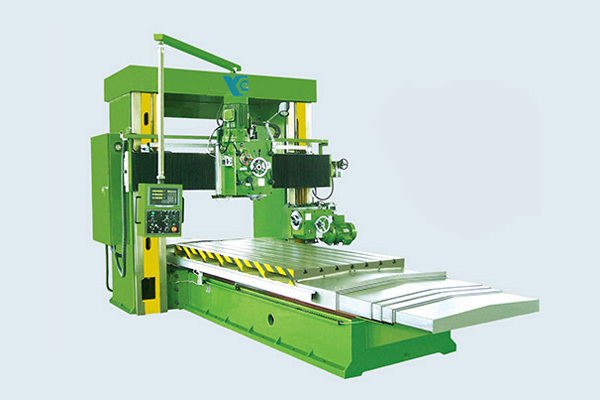
The workbench of the CNC gantry machining center is basically rectangular, and the workbench, bed, column, beam, gate plate and other large castings of the gantry machining center are made of cast iron or welded parts. The inner cavity of the casting is a honeycomb composite structure with advanced design. All parts are aged and tempered. Eliminate residual internal stress, stabilize materials, and ensure the stability of workpiece machining accuracy and machine tool life.
CNC gantry machining centers include fixed beam type (beam fixed, table moving/rotating), moving beam type (cross beam moving up and down, table moving back and forth), moving column type (table fixed, gantry moving), sky model (working platform fixed, working platform moving) and various gantry machining centers with the above combination forms. The characteristics, capabilities and processing purposes of the products processed by gantry machining centers are not the same.
Gantry machining center refers to a machining center whose spindle is perpendicular to the table. The overall structure of the gantry machining center is a portal rigid frame, which is composed of double columns and top beams, and a cross beam in the middle. Gantry machining centers are particularly suitable for machining large workpieces and workpieces with complex shapes.
At present, there are three internationally popular designs:
1. The gantry is fixed and the table is moving, which is equivalent to a vertical milling machine. Foreign equipment can work alone or in parallel with a double workbench.
2. Theoretically, the gantry mobile type can process workpieces of any length.
3. The beam can be moved (viaduct type) and moved on the support walls on both sides. Part of the side walls of the lightweight gantry are poured with cement piers, which has the advantage of reducing costs.
Second, the structural characteristics of CNC gantry machining center:
1. Workbench
The table of the CNC gantry machining center is basically rectangular. Large castings such as tables, beds, columns, beams and gates are made of cast iron or welded parts. The inner cavity of the casting is a honeycomb composite arrangement structure with advanced design. After aging and secondary tempering treatment, the residual internal stress is eliminated, the material is stable, and the workpiece processing accuracy and machine life stability are guaranteed.
2. Gantry
The gantry consists of a beam and two columns. It is divided into fixed beams, fixed beams with positioning blocks and random lifting.
3. Ram
Ram can be divided into open and closed type in structure. The gate plate of the open structure is clamped on the spindle box by the pressure plate, and the cross-sectional area of the gate plate is large; The gate plate of the closed structure is sandwiched in the spindle box, and the cross-sectional area of the gate plate is small.
4. Tool magazine
There are three basic types of tool magazines for CNC gantry machining centers: turret type, drum type and chain length type.
5. Attachment header library
The machining of large, complex parts often requires many attachment heads. The connector is specially designed by the CNC gantry machining center according to the processing requirements of the workpiece. It is generally divided into right angle head, extension head, special angle head and general head.
6. CNC system
There are many suppliers of CNC systems, and different system brands and models are selected according to different needs.
7. Accuracy
Machine tool accuracy is the original accuracy of an exponentially controlled gantry machining center without external loads. Accuracy is usually represented by its opposite – deviation from the ideal state (error for short). The smaller the error, the higher the accuracy.
Related information

Tel
Sales001@ntyczn.com Sales002@ntyczn.com
Add
No. 9, Daming Lake Road, Suxitong Park, Nantong City, Jiangsu Province
Copyright © Yongchang Intelligent Equipment (Nantong) Co., Ltd All Rights reserved. | SEO | Global site